5-Stand Sporting Clays
The shooting stations are numbered starting from the right with 1 and moving to the left with 2, then 3, then 4 and finally 5. Each shooting station is equipped with a menu card showing the birds to be shot at that station and how they are to be shot ie. single, double report pair or double true pair. No matter, the arrangement, shooters will shoot at 5 birds from each station using the manner described on the menu card. Like trap, the shooters shoot in order from left to right, at the targets shown on the menu card at their shooting station. Shooting starts with the left most shooting station then proceeds to the next shooter and the next shooter until all occupied stations have shot. After the first row on the card has been shot by each station, the shooters then move to the next station on their right. Thus the shooter at station 1 (shooter 1) moves to station 2, the shooter at station 2 (shooter 2) moves to station 3, shooter 3 then moves to station 4 and finally, Shooter 5 moves to station 1. Now shooter 1 begins the shooting sequence again starting from station 2. Once all shooters have shot at 5 birds, the shooters move again and resume shooting. This process continues until each shooter has shot at five birds from each station. The number of total shots taken by each shooter is not counted. Only the number of birds broken is scored. Each bird is valued at one point so that a total of 25points may be obtained in any one round. The shooter is permitted to shot up to two shots at each bird. If a double is thrown the shooter may shoot one shot at each bird or two shots at one bird but no more than two shots my be taken at any time.
NSCA 5-STAND Sporting events consist of targets shot in 25 bird increments from five shooting stands with each shooter rotating from station to station. The game offers several different skill levels and utilizes six or eight automatic traps to simulate game birds. Targets are released in a predetermined set sequence marked on a menu card in front of each shooting cage. Targets are registered separately under a special set of rules; however, they utilize the NSCA Classification system and all targets are included for total targets shot for the year. NSCA 5-STAND Sporting rules must be followed at all times while conducting this event.
A typical 5-Stand shooting station setup is shown below.
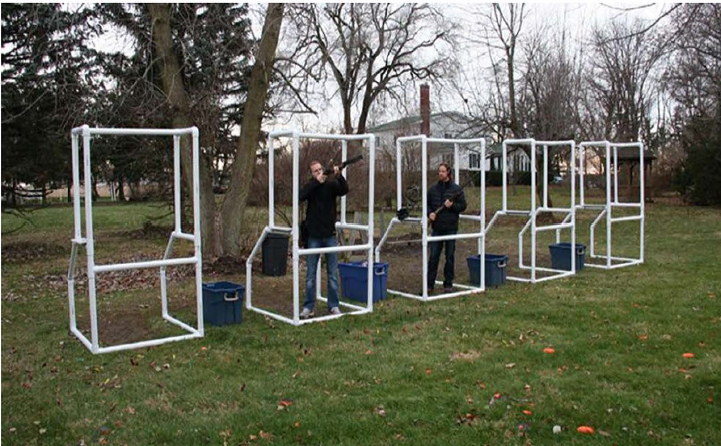
Generally a 5-stand shooting event uses between 6 and 8 traps although larger numbers of traps may be incorporated. The shooters shoot in turn at various combinations of clay birds thrown from the various traps included on the field.
A typical diagram of a 5-stand field is shown below.
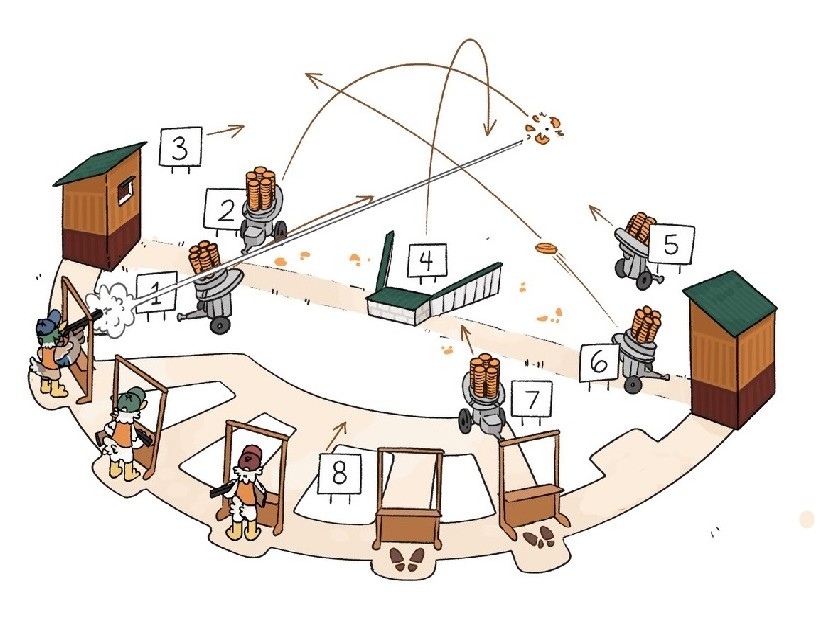
In this diagram it can be seen that there are several different types of shots. Look at the different shots to aid in understanding of the shots.
1) Rabbit: The rabbit uses a special clay target called a Rabbit Target. It is a Thick rimmed target with a reinforced flat plate body.
It is rolled rapidly along the ground from a special trap. It moves fast enough that the target skips and bounces along the ground
like a fleeing rabbit.
2) Chandelle: This is a presentation using a standard clay pigeon. It is thrown with a high arcing curve that resembles a rainbow or
infield popup in baseball.
3) Standard High House: This shot comes from the high house on the skeet field used for 5-stand. It may be thrown faster or slower,
higher or lower or inside or outside of the standard high house flight path.
4) Teal: Often thrown from the trap house area or a moveable machine placed on or just outside the skeet infield. The bird is launched vertically so that it follows basically the same path going up and coming down.
5) Chandelle: This is a presentation using a standard clay pigeon. It is thrown with a high arcing curve that resembles a rainbow or
infield popup in baseball.
6) Standard Low House: This is a bird thrown from the low house of the skeet field may be thrown faster or slower, higher or lower
or inside or outside of the standard low house flight path.
7) and 8) Various outgoing targets: The machines may be moved around the couse to produce various different outgoing shots.
9) Incoming: Not shown on the diagram is the incoming shot. Frequently a machine will be placed far out into the field and thrown
towards the shooting stations. These incoming shots can take a very long time to get close enough to hit the target. Sometimes the
target will take 20 - 30 seconds to get close enough to shoot.
Each throwing location will have a large numbered plaque placed on the throwers location. These numbers are present to aid the shooter in locating which target is being thrown at any given time.
Back